Friday, January 29, 2010

Science on Saturdays

Starting January 30 (tomorrow), there will be "a five-week series of lectures and demonstrations intended for middle and high school students" relating to science.

Three of the events relate to the environment:

The February 13 event is titled "Put it back when you are done: Storing carbon dioxide in the earth, not the atmosphere" and will be presented by Roger Aines, a scientist from Lawrence Livermore National Laboratory (LLNL), and Ken Wedel, a teacher at Tracy High School.

February 20's event is titled "Understanding climate change: seeing the carbon through the trees," and will be presented by Karis McFarlane, a LLNL scientist, and Dean Reese, a Tracy High School teacher.

And finally, on February 27, there will be an event on "Harnessing fusion energy: the power of light" by Ed Moses, a LLNL scientist. It would be great if you guys attended one or all of these and reported back to the club about what you learned--you could even write a blog post about it!

The series is held at The Bankhead Theater located at 2400 First Street in Livermore. The events are free and, for each event, there are two presentations of it on the same day. The first starts at 9:30 A.M. and the second starts at 11:15 A.M. The presentations are an hour long and seating is on a first-come, first-serve basis, so get there early! No pre-registration is required.

Some teachers give extra credit for attending, so check with your teachers if you plan on going. The events are always fascinating because the scientists who work with and have extensive knowledge on the issues are the ones presenting. At the end, there is an opportunity to ask them questions. For more information about the Science on Saturdays series, visit their website at http://education.llnl.gov/sos/?page=home.

(If you do plan on going, let us know. We can let others in the club know that you're attending and perhaps you could carpool or at least sit together at the event.)

"Flow" Film Showing

Our club is planning a showing of the documentary Flow sometime this semester. The film won multiple awards at the 2008 Sundance Film Festival and tells the story of our current water crisis. The topic relates to people everywhere, and we thought it would be a useful, inspiring, and informative movie to present to the Pleasanton community.

We will show the film for free in the multipurpose room and possibly sell popcorn or cookies at the event to raise funds for the club and help offset the cost of renting the MP. It will be open to the public and we would encourage teachers to give extra credit to students who attend. The event will be all about raising awareness for the issue the movie discusses.

Here's a link to the trailer: http://www.flowthefilm.com/trailer

From the movie's website:
"Irena Salina's award-winning documentary investigation into what experts label the most important political and environmental issue of the 21st Century - The World Water Crisis.

Salina builds a case against the growing privatization of the world's dwindling fresh water supply with an unflinching focus on politics, pollution, human rights, and the emergence of a domineering world water cartel.

Interviews with scientists and activists intelligently reveal the rapidly building crisis, at both the global and human scale, and the film introduces many of the governmental and corporate culprits behind the water grab, while begging the question 'CAN ANYONE REALLY OWN WATER?'

Beyond identifying the problem, FLOW also gives viewers a look at the people and institutions providing practical solutions to the water crisis and those developing new technologies, which are fast becoming blueprints for a successful global and economic turnaround."

For more information on the film, please visit the website at http://www.flowthefilm.com/.

Saturday, January 16, 2010

Mohr Garden Project Work Day 1 - Pulling up old plants

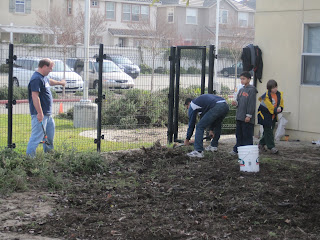
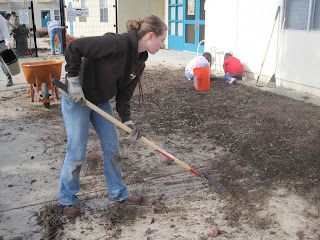
At 9:30 this morning, students, parents and a creative science teacher gathered at a local elementary school to begin the process of getting some planter areas ready for a new garden. Task #1: Remove the old plants that have been there for many years.

One of the Environmental Club Co-Presidents (left), a club member, and a student obtaining her service hours working on the section of garden that will become a drought-resistant/native plant garden.

Today, we focused on three areas that will be converted into different types of gardens. The new garden club will be designing and maintaining the gardens with the help of adult volunteers and our club.
This area will become a flower garden.

The day was spent digging out and pulling up the old plants, searching for hidden roots, and saving worms, ladybugs and frogs that were disturbed by our activites. Most worms and ladybugs went into other areas that weren't going to be eradicated, but some worms found themselves in front of Betty, the science class turtle. Frogs were brought to quiet areas on the other side of the building.
The Environmental Club Secretary separating branches from dirt after all the plants had been pulled out.

Fortunately there was a great turn out; many high school students helped out to acquire their service hours necessary to graduate, and lots of parents showed up with their children, helping get some of the larger bushes and stubborn plants out. It was a very productive day, but there is still a lot that needs to be done before planting can begin.

A club member, a high-school student, and our other Co-President working to pull out a stubborn plant.

This area will become an edible vegetable garden.

The drought-resistant/native plant area free of bushes.
Thanks to all the club members who came to help out!

Wednesday, January 13, 2010

Bulletin Green Tip #4: Reduce fireplace use to reduce pollution

This time of year, a fire in the fireplace is tradition. Since the dawn of mankind, we have been using fireplaces to warm ourselves and to cook meals. Back when the earth's population was smaller, using fire for heat everyday was great and innovative for many centuries.

Unfortunately, our population has grown exponentially, and burning fires contributes to air pollution. Try to use your fireplace as seldom as possible, and especially on spare-the-air days opt to use a heater or pile on the blankets (considering it is illegal to burn fires on spare-the-air days!) Some are upset that Christmas was a spare-the-air day this year, but it wasn't just some Scrooge regulators trying to ruin holiday traditions--the air quality that day was terrible, and to allow burning would have put everyone's health--especially those with conditions like asthma--at risk.

Also, a study found that using a fireplace to warm your house is really inefficient. According to this article on Yahoo! Green, "Another estimate found that for every $100 you spend on firewood, you get only $10 to $20 worth of heat. The traditional fireplace only warms your heart, not the room."

From the same site:
"If you upgrade to a woodstove, make sure to follow the EPA's advice:

  • Burn only dry, well-seasoned wood.
  • Never burn household garbage or cardboard.
  • Keep the doors of the wood-burning appliance closed.
  • Install and maintain a smoke alarm.
  • Install and maintain a carbon monoxide detector."

If you want that fireplace feel, there are electric fake fireplaces that you can purchase that don't emit the same type or quantity of pollution. Or put tall candles in the fireplace on a nice stand for a more subdued decorative fire.

A realistic-looking electric fireplace.

On a related note, if you don't use your fireplace, then plug and seal the chimney flue so that heat won't escape from your home.

Happy Winter!

Wednesday, January 6, 2010

Mohr garden project update

Hey everyone!

So I just got an update from Ms. Conley, and she said that the timing for Saturday Jan, 16 is 9:30 AM to 12:30. Bring gloves, water (reusable water bottles! woo!) to drink, lunch/snacks (if you wish) and tools if you can. They only have a few shovels, hoes, rakes etc.

Hope to see you there!

AVHS Environmental Club officers

Tuesday, January 5, 2010

Mohr garden project first work day

AVHS Environmental Club is going to be assisting Mohr Elementary School with its new garden! This is a very exciting opportunity for us to connect with the younger students and inspire them to appreciate nature and gardening.

The first work day will be Saturday, January 16. For those of you interested in helping out, please email the club at avhsenvironmental@yahoo.com.

Plan on wearing things that can get dirty and maybe bring some work gloves (we'll be using shovels, pulling up plants, etc.). If you have friends who need service hours/want to help, let them know about this opportunity and have them email us.

Bulletin Green Tip #3: Turn down your thermostat.

Wintertime means colder weather and resultant heaters blasting warm air into homes. Heaters can mean a lot of energy usage and high electricity bills. Reduce both by turning the thermostat down a couple degrees. Grab a blanket and bundle up in warm clothes to make up for it. It's always best to stay below 70 degrees, and when it isn't super cold outside, keep it lower. Don't forget to turn it down during the day when no one's home.For more thermostat tips to saving energy, check out this article.